Most of my hobbies are somehow related to the computer, so I'm constantly in the search stage of software to meet my needs. But the more professional is software, the more the price of all these developments. But I'm not a professional! So why should I spend big money on the purchase of certain products, if I did not earn a penny from them in the long term?
Use of limited "home" versions or "light" packages is also not an option, because they usually cut a very interesting and useful functions... So I concentrated on testing the "open source" analogues of the various programs, fortunately enthusiasts willing to share their experience are enough in the world (for what they have honor, praise and respect). But here there is one problem: the developers of professional products are focused on "loyalty" of its user, so running in parallel with the development of the product they supply it usually with serious and informative guides. But in the case of "open source" it is not always possible. It could be argued that the "good" software is clear and intuitive for the user at any level, but personal experience suggests that to read manuals is still very, very useful exercise. Because every program has its own quirks, to understand that empirically is not so simple. And manuals speed up the process at times (unless of course, they are not stretched more than a 500 pages, but in any case there is a glossary or table of contents))).
So, in search of regular manuals to music program I dug up a project called
FLOSS Manuals. List of manuals decently surprised me: besides the well expected VLC-player or a sound editor Audacity, I found a manuals for such interesting projects as Csound (audio programming) and Ardour (digital audio workstation (DAW)). Well, a manual for
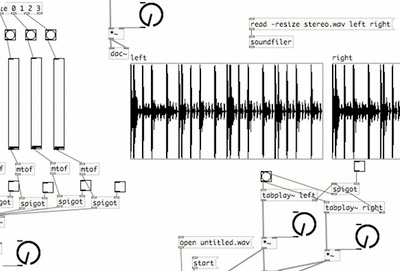
Pure Data (a program for creating interactive audio-visual applications) I think one of the most convenient, complete and easy to understand for a standard user!
My pd-patch © :)